

in this edition of our newsletter you’ll find:
🌱 Exploring the rest in resistance and the resistance in rest.
💧 Catch our next noe circle Circling Back on September 28 at 3 pm CET. Save the date!
🪴 Recommendations on rest and resistance from our noe community, including an event in Berlin.
Enjoy!
Your noe team
Did a friend forward you this email? Sign up to get your own copy of the noe newsletter to your inbox with inspiration, empathy knowledge, and community building.
Contribute! You would like to contribute to our community column, be featured by our noe stories, or join our next noe circle? Shoot us an email: contact@networkofempathy.org
🌱 Planting Seeds
In this section we share thoughts and concepts around empathy that have inspired us and made us think.
The Rest in Resistance & the Resistance in Rest
“Rest, in its simplest form, becomes an act of resistance and a reclaiming of power because it asserts our most basic humanity. We are enough.”
Tricia Hersey, author of “Rest is Resistance: A Manifesto”
Have you ever taken an afternoon off and felt extremely guilty? Was your mind swarmed with repeated echoes of “You should be doing something!" or “Stop being lazy!”. Whatever that unknown something is! Have these judgmental thoughts around “productivity” haunted your mind? If so, you are not alone. Since the rise of industrialism, we have been socialized and hard-wired into believing that being productive is tied to our self worth and value. However, this reverence given to hyper-productivity originates from capitalist values endorsed and promoted by capitalist employers. While this originated as a tactic to control and govern labor workers for the sake of maximizing efficiency and productivity regardless of the human wellbeing, it has become an internalized and damaging principle. Therefore, unsurprisingly we, humans, have developed a troubled relationship with rest. From the minuscule daily activity to our life achievements, our benchmark of satisfaction is based on our productivity -on what output we can produce.
Cara New Daggett offers an interesting perspective on productivity. In her book The Birth of Fossil Fuels, Thermodynamics, Energy, & the Politics of Work, she explores the history and development of labor and industrialization. She asserts that the industrial age of energy and machinery introduced a new kind of competition to human labor. Energy allowed the use of new tactics for labor governance, all focused on the maximization of efficiency and productivity. For the first time, work had become measurable in terms of both quality and quantity, and time became the preferred method to ensure labor discipline. By the nineteenth century, wage labor (being paid by time worked) overtook the former tradition of taken-work, where one was paid by the task. With work being controlled by time, the waged worker now had to match the speed of its new colleagues: machines. This was a shift to completely new ways of dividing and organizing work and leisure. Nonindustrial work was not as rigid in this separation between leisure and labor, and most notably, each individual was in control over their own working life.
Pro-industrialists and akin reformers disapproved of taken-work as it would result in too little to sell and left workers with too much control over their time. They believed if left idle, the public would resort to vices and immoral leisure such as drinking, prostitution, and crime. Work became a moral concern. Waged labor was also not only a means to standardize workers’ time, but to instill the notion that “time equals money”. This meant that the time that was not put to good use, or to productivity, was time wasted. Subsequently, leisure became an isolated activity, bound to short moments in the week rather than interspersed throughout the day at an individual’s will.
Daggett further elaborates that by the end of the nineteenth century, social reformers behind the industrial movement became preoccupied with the scientific evaluation of work. With that, work additionally became a physiological problem. This science came with “a modernist politics, the politics of a state devoted to maximizing the economy of the body” and to “a new kind of productivism”. The new science of ergonomics, or efficient movement, did not emerge to discuss time and space, but energy as it pertains to human labor power. Now, an employer no longer measured output or time worked alone, but would need to take into account the energy flows into the labor system. In pursuit of moral and physical optimization, the work-life balance phenomenon emerged as a new tactic of governance. Thus, issues of overwork and underwork were approached as a problem of imbalance that was curable through adjusting inputs and outputs -and energy was the best unit for optimal balancing.
Following these socio-economic developments in labor and labor governance, the emergence of social Darwinism, and the invention of the new “Rational Self of Man”, the human has become primarily an economic subject. The European colonizer no longer defined themselves by virtue of religion, and, therefore, no longer defined the “other” by their religious heresy, but by their “political condemnation”, which included those who were occupied, colonized, oppressed, and enslaved. The determining characteristics of “otherness” further evolved to be based on economic activity, productivity, and wealth. The elite have become the Breadwinners and Investors and the other are the economically damned: the jobless, homeless, the Poor, and the “undeveloped”.
This brief discussion on productivity and rest highlights a few key issues on the former notion. First, it is a manufactured concept designed to control worker’s time that has evolved into an internalized social value. However, it originates from values of materialism, capitalism, and maximizing efficiency and productivity. Second, humans are viewed as economic subjects and they, including their activities, are valued based on their material output and the efficiency and management of their energy flow. Third, it is an imperialist, colonial concept used as a signifier of differentiation between the colonizers and the colonized.
Therefore, resting is indeed resisting the current capitalist, neo-liberal, and colonial system that seeks to control workers’ and their lives, time, and autonomy. When we think of resistance, we often think of big actions - perhaps a protest or demonstration. However, it is the small acts of individual ownership, of taking back control over your time and your experience of it, that can be strong acts of resistance. Each individual together can bring about a social movement to take back our agency. Connecting to your body, respecting your needs, prioritizing your and your community’s wellbeing is a collective fight against a system that is built and thrives on human exploitation.
We can take a few lessons to learn from Kaitlin B. Curtice. In her book, Living Resistance: An Indigenous Vision for Seeking Wholeness Every Day, Curtice discusses four realms of resistance: the personal, the communal, the ancestral, and the integral. She emphasizes the importance of daily resistance against the interconnected systems of oppression that have promoted disconnection from each other and indigenous or local traditions, individualism, and a hyperfixation on productivity. Curtice shares a few examples of such as “practicing embodied ways of belonging and connection to ourselves and others in our daily lives such as getting in touch with our bodies, resting, and remembering our ancestors”.
We can see that the movement, rest is resistance, fits within the larger struggle and strive for collective liberation and system change.
💧 Watering the Mind
In this section we share updates from the noe team and concrete offers that allow you to build emotional intelligence and resilience skills.
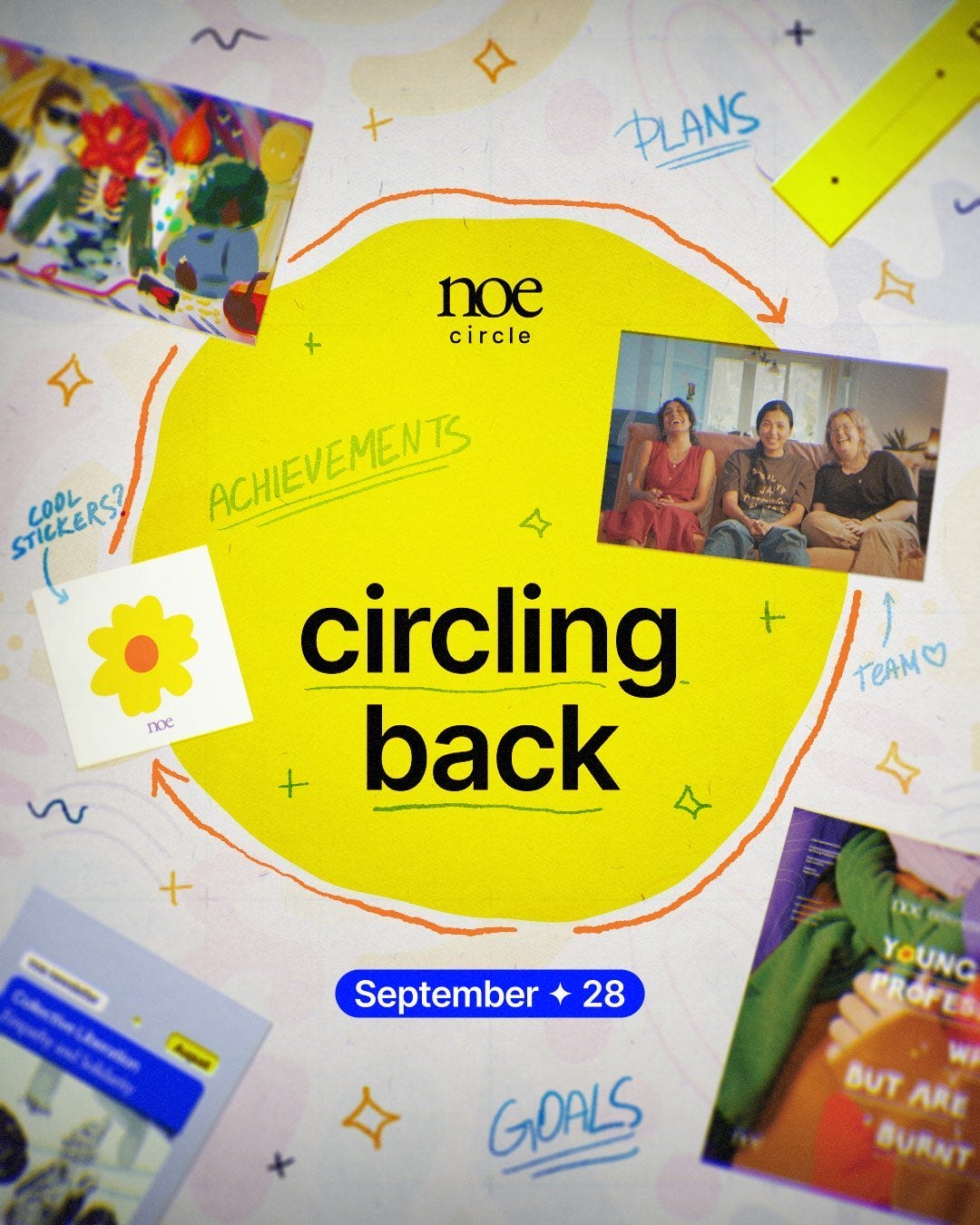
Our upcoming noe circle this September 28 at 3 pm CET
None of us exist in isolation; we are all interconnected, like the roots of a great tree.
Our lives are deeply woven into the fabric of those around us, but for many of us passionate about contributing to societal and systemic change, overwhelm and burnout can sever that connection. Rooting ourselves in community, empathy, and self-care practices helps us reconnect with ourselves, others, and our purpose. This grounding provides the strength to navigate uncertainty, foster resilience, and reignite passion for the change we seek. All upcoming NOE Circles are designed to help you find that connection, exploring themes of interconnectedness and rooting in order to restore balance and wellbeing.
The three main themes we’ll focus on are: relationship to self, interpersonal connections, and change, following the NOE Experience methodology. Through these lenses, we will deepen our understanding of how to cultivate inner stability while driving impactful, sustainable transformation in the world around us.
Our upcoming circle, taking place September 28 at 3pm CET via zoom, is an opportunity to re-connect with ourselves and our noe community. Following the theme “Circling Back” we’ll hold space to check in with each other and root ourselves in community.
Are you interested in joining our September circle?
If you would want to join our community or support us, don’t hesitate to get in touch at contact@networkofempathy.org.
🪴 Vines of Community
In this space we foster connection and inspiration by sharing stories, poems, and thoughts of community members.
For September, members of our noe community have shared some community events and book and music recommendations on rest and resistance and to help you rest in resistance.
Community Event (online)
Eszter is offering an Autumn Equinox Reflection Hour on September 23 at 6pm CET via Zoom and for our noe community members participation is **free**. The event offers an opportunity to take stock of your inner ressources and set goals for the rest of the year.
Books
The Birth of Fossil Fuels, Thermodynamics, Energy, & the Politics of Work by Cara New Daggett.
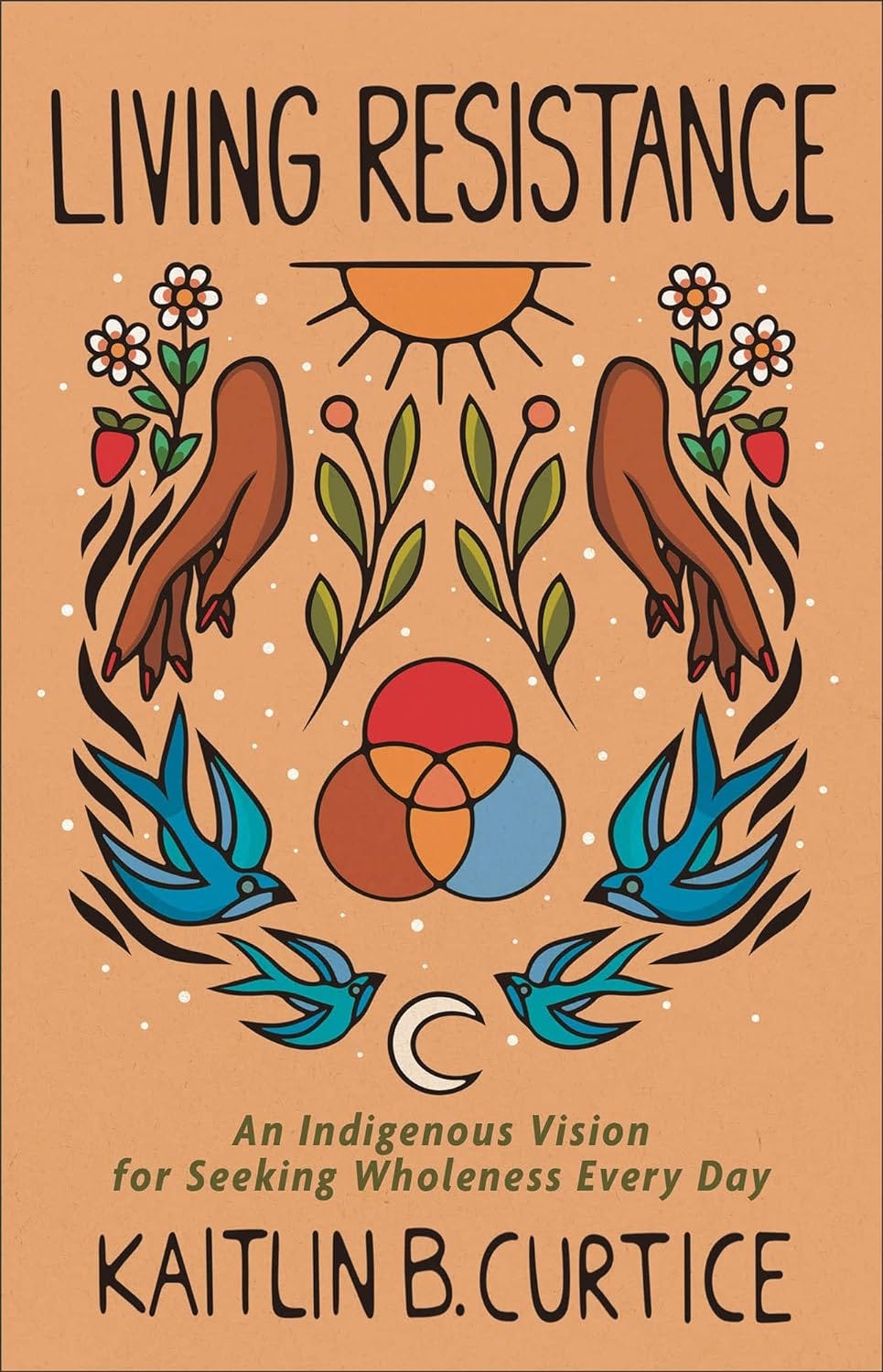
Living Resistance: An Indigenous Vision for Seeking Wholeness Every Day by Kaitlin B. Curtice.
“Resistance is for every human who longs to see their neighbors' holistic flourishing. We each have a role to play in the world right where we are, and our everyday acts of resistance hold us all together.”
Froom Living Resistance: An Indigenous Vision for Seeking Wholeness Every Day
Music
For some self-care and love:
Crushin’ by Meghan Trainor (ft. Lawrence)
To inspire you to get some well-deserved rest:
Put Your Records On by Corinne Bailey Rae
Do You Wanna Do Nothing with Me? by Lawrence